
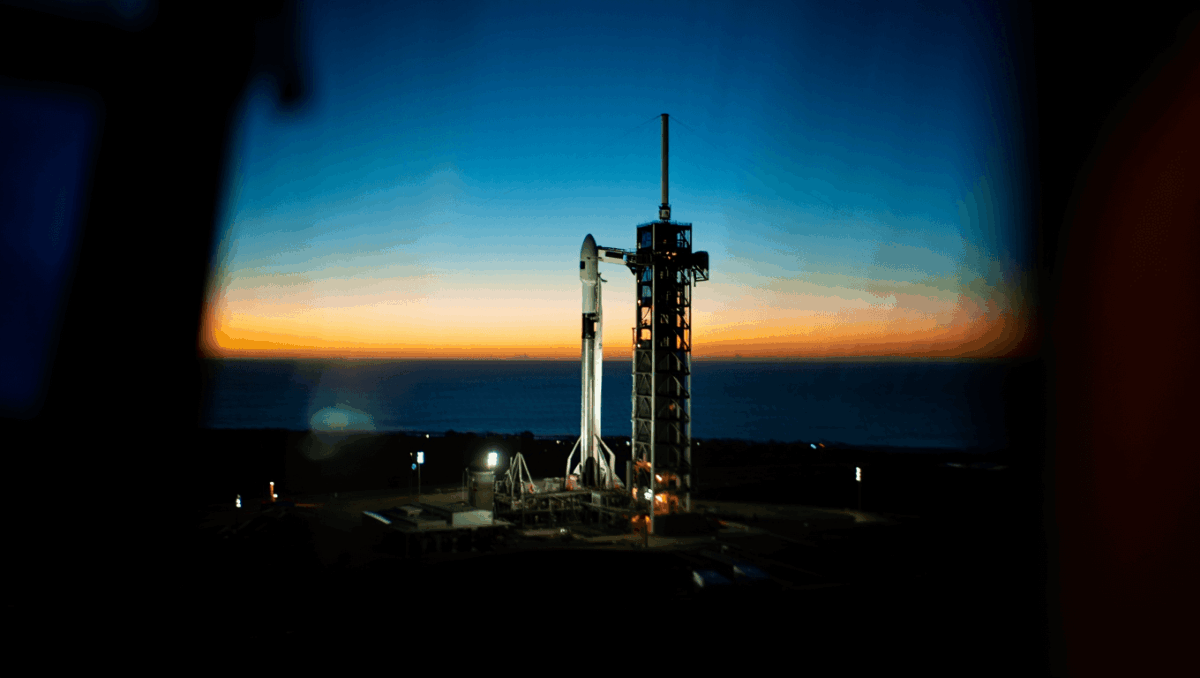
SpaceX launches Cosmo-SkyMed Earth observation satellite for Italy tonight from California, marking the aerospace company’s first orbital mission of 2026. A Falcon 9 rocket is scheduled to lift off at 6:09 PM PT from Vandenberg Space Force Base in Santa Barbara County, carrying a critical resource for Italian earth observation capabilities. This advanced satellite represents one of Italy’s largest space investments.
🔥 Quick Facts
- Launch Time: January 2, 2026 at 6:09 PM PT (9:09 PM ET) from Vandenberg Space Force Base
- Satellite Weight: 1,700 kilograms (3,748 pounds) designed for dual civilian and military earth observation
- Technology: X-band synthetic aperture radar (SAR) with spotlight-mode resolution as fine as 0.3 x 0.5 meters
- Historic Mission: One of Italy’s largest investments in space systems for earth observation with 2 planned second-generation satellites
SpaceX Opens 2026 with Italian Earth Observation Mission
Intuit emerges as best software stock for 2026 while stock crashes to bargain levels analysts didn’t expect
2026 tax brackets shock Americans with hidden paycheck truth nobody expected
Tonight’s launch represents a significant milestone for both SpaceX and the Italian Space Agency (ASI). The Cosmo-SkyMed Third Flight Model (CSG-FM3) satellite will join an expanding constellation designed to monitor Mediterranean basin activities with unprecedented radar imaging capabilities. SpaceX’s Falcon 9 has become the trusted heavy-lift partner for international earth observation initiatives.
This mission kicks off what promises to be an active 2026 launch schedule for SpaceX after the company concluded 2025 with a record-breaking 165 orbital flights. The California deployment showcases SpaceX’s commitment to supporting global space infrastructure goals while maintaining operational momentum at Vandenberg Space Force Base.
Advanced Radar Satellite Specifications and Capabilities
| Specification | Details |
| Satellite Mass | 1,700 kg (3,748 lbs) |
| Radar Type | X-band Synthetic Aperture Radar (SAR) |
| Resolution (Spotlight Mode) | 0.3 x 0.5 meters |
| Imaging Modes | Spotlight, Stripmap, Pingpong, Quad Polarization, ScanSAR |
| Daily Coverage | 520 dual polarization images from single satellite |
Marcus Lemonis takes CEO role at Bed Bath & Beyond with $25M cost-cutting plan and watch what industry experts are saying about his next move
SPX surges 34 points at open with shocking tech recovery, here’s what caused the unexpected Venezuela rally
The Cosmo-SkyMed constellation operates as the world’s first dual-use earth observation system, serving both civilian and military applications simultaneously. The satellite’s advanced radar imaging capabilities penetrate cloud cover and operate during daylight or darkness, providing consistent monitoring regardless of weather conditions. Italy’s investment in this constellation demonstrates confidence in space-based earth observation as a critical infrastructure asset.
Italy’s Strategic Investment in Space-Based Earth Observation
The Italian Space Agency has positioned Cosmo-SkyMed as Italy’s flagship earth observation program, representing the nation’s largest investment in space systems for planetary monitoring. This constellation provides independent data access for environmental monitoring, urban planning, disaster response, and maritime surveillance across the Mediterranean region. Leonardo and Telespazio serve as primary contractors for the advanced satellite systems.
Italy’s commitment to expanding this constellation from two second-generation satellites to full operational capacity signals growing recognition of space-based intelligence as essential for modern governance. The system’s ability to acquire high-resolution imagery repeatedly changes how countries respond to emergencies and monitor infrastructure development across vast territories.
SpaceX Mission Operations and Falcon 9 Recovery Sequence
Tonight’s launch will follow SpaceX’s established California operations protocol from Space Launch Complex 4E. The Falcon 9’s first stage will execute a boostback burn before attempting a landing at the Landing Zone near Vandenberg, allowing rocket component reuse. This recovery strategy reduces mission costs and accelerates SpaceX’s ability to manifest rapid-succession launches throughout 2026.
The mission timeline includes key milestones beginning with Max Q (maximum aerodynamic stress) at approximately 1 minute 12 seconds post-launch. First stage engine cutoff occurs at 2 minutes 15 seconds, followed by stage separation. The second stage continues eastward, placing the console at optimal deployment altitude. Satellite deployment occurs approximately 12 minutes 52 seconds after liftoff, sending the CSG-FM3 into a sun-synchronous orbit perfect for consistent earth observation.
What This Launch Means for International Space Commerce and Earth Observation Markets?
Tonight’s successful deployment would strengthen SpaceX’s position as the world’s leading commercial launch provider while advancing Italian space independence. The mission demonstrates how international partnerships between space agencies, commercial operators, and satellite manufacturers create resilient infrastructure for global monitoring capabilities. Vandenberg Space Force Base continues its critical role supporting both national security and allied space missions.
As earth observation demand accelerates amid climate change, infrastructure aging, and security concerns, the Cosmo-SkyMed constellation expansion reflects growing market recognition. Nations worldwide recognize that independent space-based sensing capabilities provide irreplaceable information advantages. Tonight’s launch sends Italy’s latest surveillance tool into orbit, supporting the European Union’s broader Copernicus earth observation initiative while maintaining sovereign imaging capabilities.

Patrick Graham is a business and finance journalist translating Wall Street’s complexities into stories that matter to everyday readers. With extensive experience in financial journalism and economic analysis, this expert journalist provides sharp insights on market trends, corporate developments, and the economic forces affecting daily life. His reporting helps readers make sense of the business world’s biggest moves.