
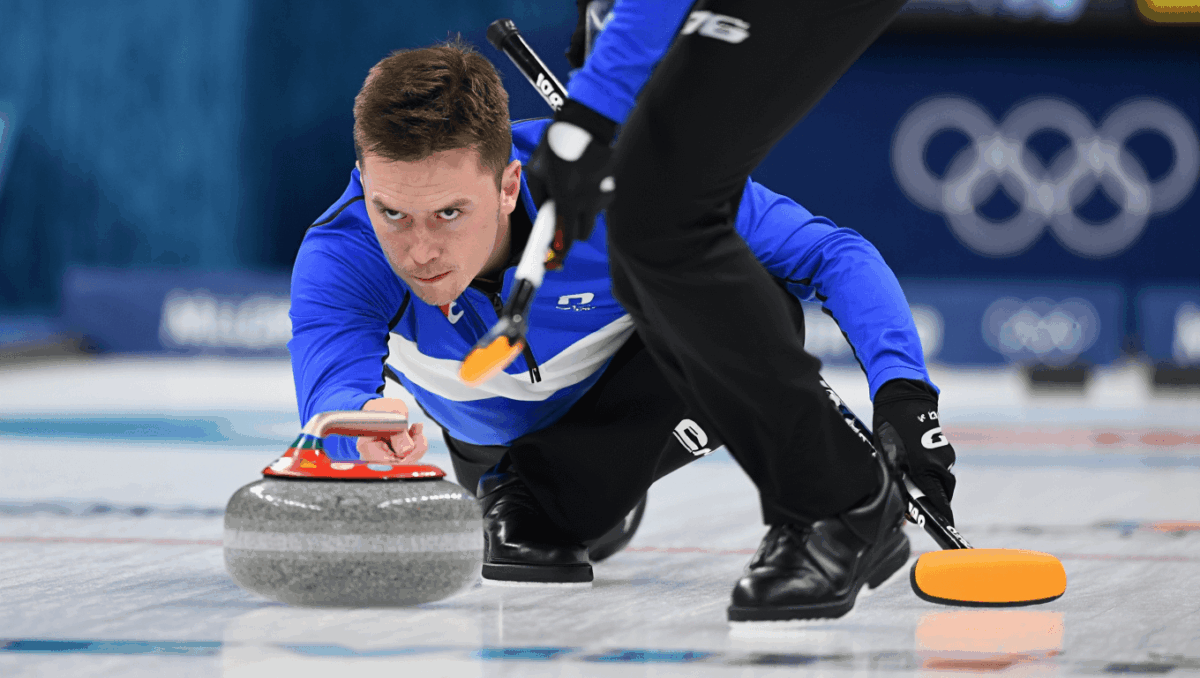
How does curling work? This Olympic sport teams slide granite stones down ice toward a target, but there’s far more strategy involved. The sweeping technique can change a stone’s path by up to 3 meters, making it crucial for winning matches.
🔥 Quick Facts
- Stone Weight: Each curling stone weighs over 20 kilograms, requiring precise technique.
- The Sheet: The ice is pebbled, not smooth, creating friction that sweepers actively reduce.
- Game Length: Matches consist of 10 ends, with each team throwing 16 stones total per match.
- The Hammer: The team throwing last holds a crucial advantage in strategy and scoring.
The Ultimate Team Sport: Understanding Basic Rules
World Baseball Classic 2026 bracket revealed: which teams advance and when to watch
World Cup 2026: three teams set to inherit Iran’s qualification spot
Curling matches involve two four-person teams competing in men’s and women’s divisions, plus mixed doubles with two players per side. Each player throws two stones per end, alternating with the opposing team. The skip captains the team and directs strategy from the house.
The winning team is the one with more stones closest to the button, the center of the target. If a team gets multiple stones closer than their opponent, they score multiple points. A blank end means no team scores that round. The team with the hammer throws positionally last, giving them a potential tactical edge.
How the Stone’s Path Changes on Ice
Caitlin Clark powers Team USA to dominant win over Senegal in FIBA World Cup qualifier opener
USA moves into WBC quarterfinals after Italy stuns Mexico
Players release the granite stone with a slight clockwise or counterclockwise rotation, causing it to curl naturally down the pebbled sheet. The ice surface isn’t flat, it features tiny frozen water droplets that create friction. These granules can significantly alter the stone’s trajectory if left untouched.
The 150-foot ice sheet measures only 16 feet wide, making precision essential. Without any intervention, the stone curves gradually across this narrow channel. Understanding this natural movement is key to executing every shot type: guards, draws, and powerful take-outs.
The Critical Role of Sweeping in Winning Strategy
Sweeping reduces friction between the stone and ice, a scientific principle that transforms curling into chess on ice. When sweepers brush vigorously, the heat generated melts the pebbled surface, creating a thin water layer. This allows the stone to glide further, travel in a straighter line, or reduce its curl.
| Sweeping Effect | Result on Stone |
| Strategic Sweeping | Extends distance by up to 2-3 meters |
| Reduced Sweeping | Increases curl, changes path direction |
| Elite Sweepers | Athletes comparable to 400m runners |
| World Curling Rules | Strict brush head standards since 2016 |
Top teams employ two or three elite sweepers with athletic profiles closer to sprinters than general athletes. Their physical conditioning directly impacts a team’s competitive success. Recent rule changes in January 2026 restricted certain sweeping techniques to ensure fair play across all competitors.
“Sweeping reduces friction between the stone and the ice, helping athletes control the stone’s speed, trajectory and curl according to the team’s strategy.”
— Olympics.com, Official Olympic Coverage
The Equipment Evolution: From Corn Brooms to Carbon Fiber
Curling brooms have undergone dramatic transformation over decades. Until the mid-1950s, players used household-style corn-straw brooms that were heavy and cumbersome. By the 1960s, synthetic materials revolutionized the sport, introducing lighter, more efficient artificial brushes.
Modern broom handles utilize hollow carbon fiber or fiberglass construction, while brush heads must meet strict World Curling standards updated in 2025. Advanced teams now train specifically on sweeping techniques, developing methods to shift bodyweight efficiently onto handles. This equipment revolution directly enabled the sport’s evolution from recreational to elite Olympic status.
Why Is Olympic Curling Thriving at Milano Cortina 2026?
Curling competitions run from February 4 to 22 at the Cortina Curling Olympic Stadium in Cortina d’Ampezzo. Three events feature competition, women’s, men’s, and mixed doubles, with ten national teams in each division. The United States just claimed its first-ever mixed doubles medal, signaling the sport’s growing global competitiveness.
What makes curling fascinating? It’s the perfect blend of physics, strategy, and athleticism, where a millimeter difference determines Olympic medals. Sweeping matters because it’s where science meets split-second decision-making, where elite athletes must read ice conditions and execute perfectly under pressure. For fans watching live or streaming, curling delivers genuine uncertainty and dramatic moments in every single end.