
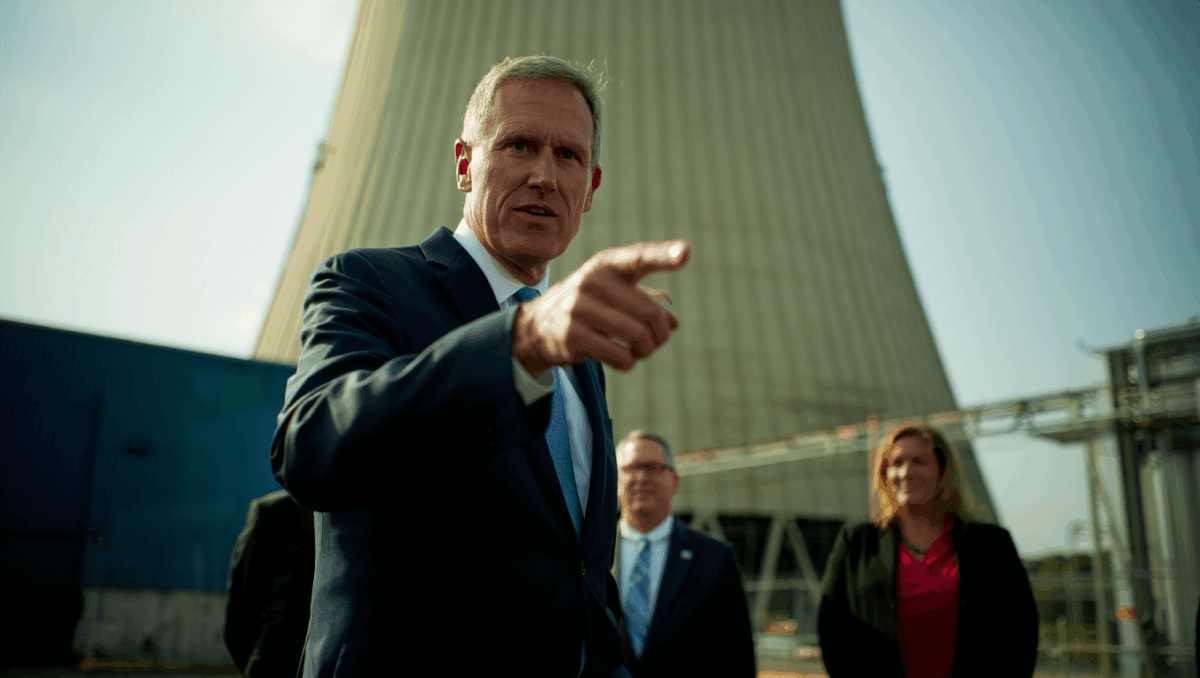
Three Mile Island is back in play as the Trump administration accelerates the nuclear restart to power Microsoft data centers. Today’s visit from Energy Secretary Chris Wright signals full government support for a summer 2027 comeback that could reshape America’s AI energy strategy.
🔥 Quick Facts
- $1 billion federal loan closed by Department of Energy in November to restart the reactor
- Constellation Energy planning summer 2027 restart after accelerating timeline by one year
- 835-megawatt reactor capacity sufficient to power 800,000 homes or fuel Microsoft’s AI operations
- 20-year power agreement with Microsoft worth approximately $16 billion total value
Energy Secretary Calls Three Mile Island Trump’s ‘Poster Child’
Intuit emerges as best software stock for 2026 while stock crashes to bargain levels analysts didn’t expect
2026 tax brackets shock Americans with hidden paycheck truth nobody expected
U.S. Energy Secretary Chris Wright toured the site yesterday, calling the restart of Three Mile Island the “poster child” of President Trump’s energy and artificial intelligence agenda. Wright emphasized that nuclear power remains the only energy source addressing the growing electricity demands of data centers without carbon emissions.
Constellation Energy CEO Joe Dominguez announced the company is spending $1.6 billion total to restart Unit 1, now rebranded as the Crane Clean Energy Center. The facility shuttered in 2019 after struggling to compete with cheaper natural gas plants. Today, artificial intelligence has changed everything about its economics.
Microsoft’s $16 Billion Bet on Carbon-Free Power
Marcus Lemonis takes CEO role at Bed Bath & Beyond with $25M cost-cutting plan and watch what industry experts are saying about his next move
SPX surges 34 points at open with shocking tech recovery, here’s what caused the unexpected Venezuela rally
Microsoft signed a 20-year power purchase agreement to buy the plant’s entire output through its cloud computing and data center operations. The tech giant’s commitment represents a strategic shift: major technology companies now compete to sign long-term nuclear deals as AI workloads consume unprecedented electricity quantities.
Bobby Hollis, Microsoft’s Vice President of Energy, stated the company views the Crane restart as a “once-in-a-lifetime opportunity” to add proven, clean generation quickly. Nuclear plants operate at near 96% capacity factor, making them far more reliable than intermittent renewables for continuous AI training and inference operations.
The PJM grid operator, which serves 13 states including Pennsylvania, forecasts data centers alone will require 30 gigawatts of new capacity by 2030 equivalent to powering over 22 million homes.
Timeline, Timeline, Investment Breakdown
| Milestone | Target Date |
| Total Constellation Investment | $1.6 billion |
| Federal DOE Loan | $1 billion (closed Nov 2025) |
| Reactor Fuel Load | Q2 2027 |
| Full Operation | Summer 2027 |
| Plant Capacity | 835 megawatts |
| License Renewal Target | 2054 |
The Grid Connection Bottleneck Threatens Timeline
Dominguez identified the biggest obstacle: getting PJM grid operators to fast-track the interconnection process. PJM faces a years-long backlog of projects seeking grid connection, but Constellation argues its national security and AI infrastructure importance warrant priority treatment. Energy Secretary Wright promised agency intervention to accelerate the process.
Safety upgrades and Nuclear Regulatory Commission approval round out remaining requirements. Wright stressed nuclear’s exceptional safety record, noting that the 1979 Unit 2 partial meltdown caused zero deaths and no serious health impacts. Modern technology prevents such failures beforehand through automated detection systems.
Does Powering AI Data Centers Actually Lower Electricity Costs?
Energy Secretary Wright directly disputed claims that data center proliferation drives up electricity prices. “Growing demand and steadier demand from data centers on grids is a surefire way to drive down electricity prices,” he told reporters. Wright pointed to price spikes in California, Massachusetts, and New York as evidence of inadequate generation capacity and poor energy policy, not data center demand itself.
The PJM capacity auction released yesterday set record-high clearing prices for 2027/2028, marking the third consecutive year where data center demand pressured electricity supplies. Industry analysts expect this trend to continue absent rapid nuclear and generation additions.
“The technology failure that led to the partial meltdown would not happen in the new facility because updated technology would catch the issue beforehand.”
— Chris Wright, U.S. Energy Secretary
What Does Three Mile Island’s Restart Mean for America’s AI Future?
Three Mile Island represents a symbolic and strategic pivot: the site of America’s worst nuclear disaster becomes essential infrastructure for artificial intelligence dominance. 500 employees have already returned to work on the project, with hiring accelerating through 2027. The restart validates nuclear power as the only proven technology meeting AI’s insatiable 24/7 electricity demands.
Amazon Web Services signed a separate 1,920 megawatt power purchase agreement this year with Talen Energy’s Susquehanna nuclear plant. Google, Meta, and other hyperscalers are quietly exploring similar deals. The Three Mile Island restart becomes the first major validation that this strategy works, accelerating industry-wide nuclear investments.
Sources
- WESA/NPR – Energy Secretary’s statements on Three Mile Island restart
- Pittsburgh Post-Gazette – Federal loan details and timeline
- Reuters and Guardian – Initial $1 billion loan announcement

Patrick Graham is a business and finance journalist translating Wall Street’s complexities into stories that matter to everyday readers. With extensive experience in financial journalism and economic analysis, this expert journalist provides sharp insights on market trends, corporate developments, and the economic forces affecting daily life. His reporting helps readers make sense of the business world’s biggest moves.