
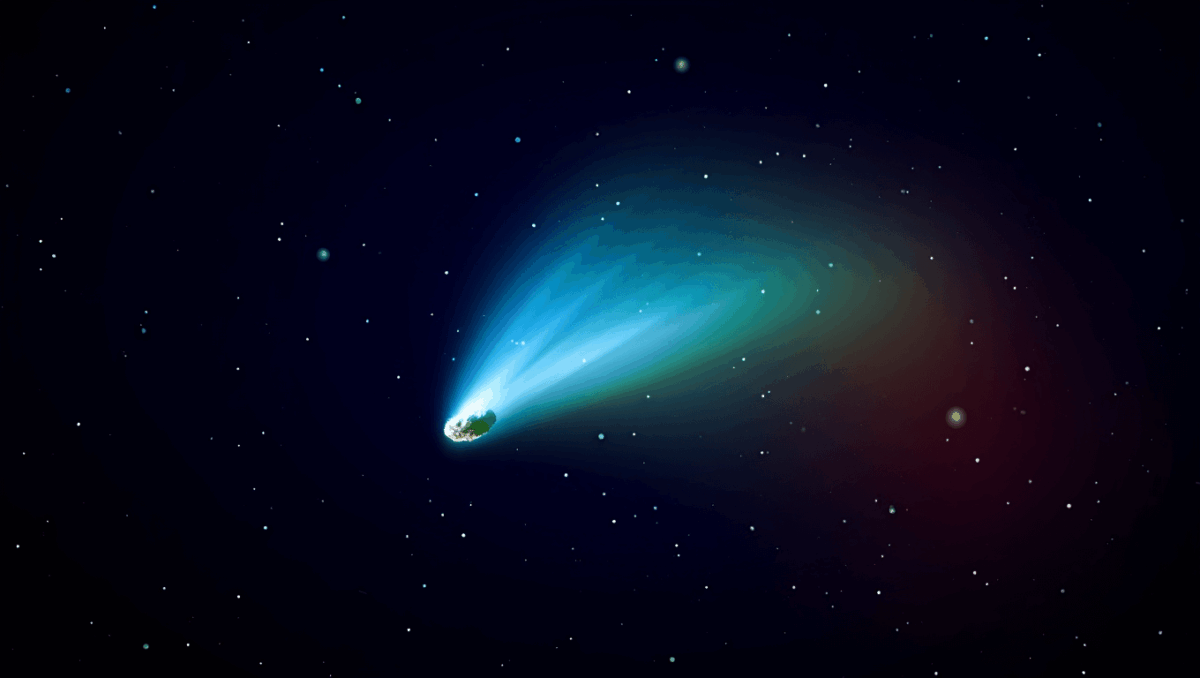
NASA’s interstellar comet 3I/ATLAS is carrying extraordinary amounts of methanol as it races toward Earth for a historic December 19 closest approach. This rare visitor from beyond our solar system holds clues about the building blocks of life.
🔥 Quick Facts
- 3I/ATLAS reaches closest approach to Earth on December 19, 2025, at 1.8 AU (170 million miles)
- Comet carries record methanol levels comparable to only one other known comet in history
- Traveling at approximately 137,000 mph through our solar system following hyperbolic trajectory
- Discovered July 1, 2025 by ATLAS project; this is the third interstellar visitor ever detected
What Makes 3I/ATLAS Extraordinary
Intuit emerges as best software stock for 2026 while stock crashes to bargain levels analysts didn’t expect
2026 tax brackets shock Americans with hidden paycheck truth nobody expected
The interstellar comet stands out for its unusual composition and extreme chemical richness. Astronomers using ALMA (Atacama Large Millimeter Array) detected the highest concentrations of methanol and hydrogen cyanide (HCN) ever observed in any comet. Only C/2016 R2 has shown higher methanol levels, making 3I/ATLAS the second most methanol-rich comet on record.
Methanol is a simple organic compound that serves as a key ingredient for life’s chemistry. Its presence in such abundance suggests this ancient visitor carries molecular materials that existed long before our solar system formed.
The Countdown to December 19
Marcus Lemonis takes CEO role at Bed Bath & Beyond with $25M cost-cutting plan and watch what industry experts are saying about his next move
SPX surges 34 points at open with shocking tech recovery, here’s what caused the unexpected Venezuela rally
As the comet approaches on December 19, 2025, NASA indicates it will reach a distance of approximately 1.8 astronomical units (AU) from Earth. That’s nearly twice the Earth-Sun distance, positioning the comet safely far from our planet. The hyperbolic trajectory means this visitor will never be gravitationally bound to our sun and will eventually escape back to interstellar space.
NASA’s Hubble Space Telescope captured new images in late November 2025, revealing detailed features of the comet’s nucleus and coma. Multiple space missions, including NASA’s Psyche and ESA’s Juice spacecraft, have tracked the object as it speeds through our solar neighborhood.
Record-Setting Chemical Profile
| Parameter | Details |
| Methanol (CH3OH) | Record enriched concentrations; second highest ever detected |
| Hydrogen Cyanide (HCN) | Extreme concentrations detected by ALMA in November 2025 |
| Carbon Dioxide (CO2) | Extreme enrichment with CO2/H2O ratio of 7.6±0.3 |
| Size (nucleus) | Estimated approximately 20 kilometers across |
The comet’s extreme chemical composition has sparked intense scientific interest. James Webb Space Telescope observations revealed CO2 as the dominant icy compound in the nucleus, a composition far different from typical solar system comets. The enhanced ratios suggest this material formed in a different stellar environment billions of years ago.
Why This Visitor Matters for Science
3I/ATLAS represents a unique opportunity to study pristine material from beyond our solar system. Astronomers are examining the comet’s isotopic ratios and molecular composition to understand how different stellar regions form planetary systems. The methanol abundance particularly interests astrobiologists studying the chemistry that could support life elsewhere in the galaxy.
The hyperbolic trajectory confirms this object originated from interstellar space, not from our own solar system’s distant Oort Cloud. Its velocity and path reveal it’s moving through our neighborhood as a true cosmic wanderer. Studies of similar objects help scientists map the interstellar material recycling between star systems.
Will You Be Able to See It?
Although 3I/ATLAS makes its closest approach on December 19, observing this comet requires binoculars or a telescope from most locations. At magnitude 8-9, it won’t be visible to the naked eye but will be accessible to amateur astronomers. NASA recommends checking local skywatching guides for the best viewing times and locations in your area. The comet will reach optimal visibility in late December as it moves through the constellation Virgo before beginning its journey back to interstellar space.
Sources
- NASA Science – Official NASA comet tracking and Hubble observations
- New Scientist – Methanol discovery and chemical composition research
- USA Today – December 19 closest approach details and viewing guidance

Patrick Graham is a business and finance journalist translating Wall Street’s complexities into stories that matter to everyday readers. With extensive experience in financial journalism and economic analysis, this expert journalist provides sharp insights on market trends, corporate developments, and the economic forces affecting daily life. His reporting helps readers make sense of the business world’s biggest moves.