
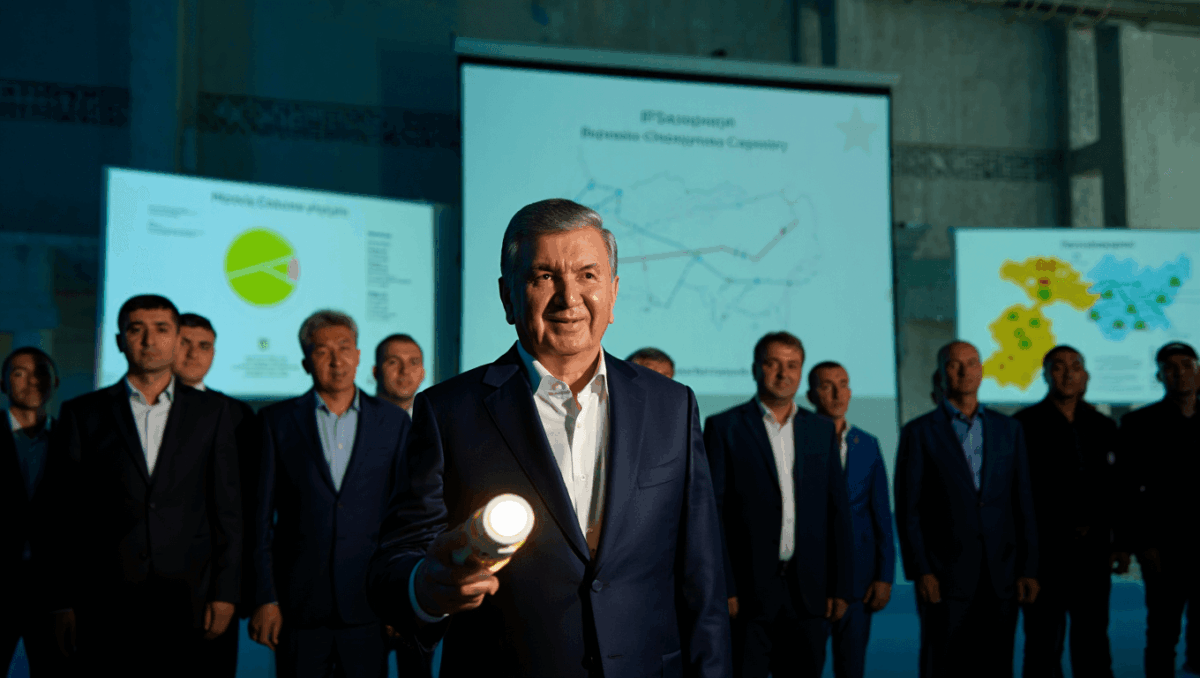
Uzbekistan unveiled its most ambitious clean energy plan yet on December 5, 2025. President Shavkat Mirziyoyev launched 42 new projects worth €9.46 billion at the “Powering the Future” forum in Tashkent. By next year, green energy will cover the entire nation’s electricity needs.
🔥 Quick Facts
- €9.46 billion investment launched across 42 new renewable, storage, and grid projects on December 5, 2025
- 23 billion kilowatt-hours of green electricity expected by 2026, fully covering national demand
- 3,500 megawatts combined capacity from 16 new solar, wind, thermal, and hydropower plants across four regions
- 11 million tons of emissions prevented annually through renewable expansion and 7 billion cubic meters of natural gas saved
Uzbekistan’s €9.46 Billion Clean Energy Surge Begins Today
Intuit emerges as best software stock for 2026 while stock crashes to bargain levels analysts didn’t expect
2026 tax brackets shock Americans with hidden paycheck truth nobody expected
The announcement marked a watershed moment for Central Asia’s energy transformation. International partners from Saudi Arabia, Turkey, UAE, China, France, and Qatar joined Uzbek officials to witness the historic commissioning. The World Bank, European Bank for Reconstruction and Development (EBRD), and Asian Development Bank (ADB) all sent representatives, signaling strong global support. The projects include 16 generation facilities producing solar, wind, thermal and hydroelectric power with combined capacity reaching 3,500 megawatts. Once fully operational, these plants will generate 15 billion kilowatt-hours annually.
President Mirziyoyev emphasized that reliable energy remains critical for economic growth. “We have set two major objectives as our main priorities. The first is to ensure reliable and uninterrupted energy supply for all sectors and regions. The second is to achieve this goal through modern, environmentally friendly, and renewable alternative energy sources,” he stated. The government also commissioned 11 substations and built 420 kilometers of high-voltage transmission lines to stabilize the national grid.
Energy Storage Revolution Powers Peak-Hour Demand
Marcus Lemonis takes CEO role at Bed Bath & Beyond with $25M cost-cutting plan and watch what industry experts are saying about his next move
SPX surges 34 points at open with shocking tech recovery, here’s what caused the unexpected Venezuela rally
A cornerstone of Uzbekistan’s plan involves 10 utility-scale energy storage systems with 1,245 megawatts of capacity. These battery facilities will inject up to 1.5 billion kilowatt-hours during peak hours, solving the intermittency challenge plaguing renewable grids. Battery storage technology addresses a critical weakness in solar and wind systems, allowing electricity generated during daylight and windy periods to be released when demand peaks. The storage systems represent one of Central Asia’s largest investments in grid stabilization technology. Two major manufacturing enterprises—Angren Energo and Uzhydropower—will produce transformers and hydroelectric units, creating domestic suppliers for future projects.
| Project Category | Capacity/Count | Annual Generation |
| Solar, Wind, Thermal, Hydropower Plants | 16 plants / 3,500 MW | 15 billion kWh |
| Energy Storage Systems | 10 systems / 1,245 MW | 1.5 billion kWh (peak) |
| High-Voltage Transmission Lines | 420 km / 11 substations | Grid stability support |
Global Energy Giants Invest in Uzbekistan’s Future
ACWA Power from Saudi Arabia remains the most active international investor. “Uzbekistan’s energy mix is becoming greener every year. This year alone we added more than 2,500 megawatts to the grid,” said Jon Zaidi, the company’s Country Head. France’s Voltalia recently signed for a 200-megawatt hybrid wind and storage project, with another 500-megawatt storage facility called Turan expected to begin construction in 2026. Meanwhile, Electricité de France (EDF) continues building two major gas-fired power plants alongside partners from Japan, Qatar, and Germany. Over recent years, Uzbekistan attracted approximately €30 billion to the energy sector, adding 9,000 megawatts of new capacity since 2017 and raising total electricity generation from 60 billion to 85 billion kilowatt-hours annually.
“All the projects we are launching today will become a source of sustainable economic growth and open new opportunities for future generations. Through these determined steps, we will undoubtedly build a modern, next-generation energy system.”
— Shavkat Mirziyoyev, President of Uzbekistan
2030 Vision: 54% Renewable Energy Powers Central Asia
Uzbekistan has set an aggressive timeline for its energy transformation. By 2030, the government plans to add 17,000 megawatts of renewable capacity, increasing the green energy share to 54 percent of total generation. This requires constructing 6,000 kilometers of high-voltage networks, with 1,000 kilometers planned for 2026 alone. The Ministry of Energy has begun transferring regional grids to private operators through public-private partnerships. Turkey’s Aksa Elektrik now manages Samarkand’s power networks, with plans to modernize grids in Jizzakh, Syrdarya, Namangan, and Tashkent by 2027. The approach aims to reduce losses and introduce international management practices. Additionally, a community solar program will install 107 megawatts of rooftop and micro-solar plants across 300 mahallas (neighborhoods), supplying 30,000 low-income families with green energy and income opportunities.
What Will Uzbekistan’s Carbon-Free Future Look Like?
The emissions reductions are extraordinary. Clean energy expansion will save nearly 7 billion cubic meters of natural gas annually while preventing 11 million tons of harmful emissions from entering the atmosphere. Uzbekistan’s Energy Minister Jurabek Mirzamakhmudov emphasized that renewable growth transforms both environment and economy. At COP-30 in Brazil, Uzbekistan reported progress on the iCraft initiative with the World Bank, which has accounted for 23 million tons of verified emissions reductions. The country recently launched a carbon-credit trading system, with 17 domestic industrial companies already adopting international green-energy certification. The government aims to increase this to 100 companies within two years. Entrepreneurs are expanding small hydropower too—40 micro-hydro plants with 40 megawatts combined capacity generated 120 million kilowatt-hours this year, with another 65 megawatts planned for 2026, improving electricity access for 80,000 households. Regional cooperation is accelerating as well, with Uzbekistan, Kyrgyzstan, and Kazakhstan planning to finance the Kambarata-1 hydropower project beginning next year, strengthening Central Asia’s shared water-energy system.
Sources
- Euronews – Comprehensive coverage of the €9.46 billion clean energy announcement and project details
- Qazinform – Official government statements and international partnership announcements from December 5 ceremony
- Daryo – Strategic plans through 2030 and regional cooperation initiatives for energy development

Patrick Graham is a business and finance journalist translating Wall Street’s complexities into stories that matter to everyday readers. With extensive experience in financial journalism and economic analysis, this expert journalist provides sharp insights on market trends, corporate developments, and the economic forces affecting daily life. His reporting helps readers make sense of the business world’s biggest moves.