
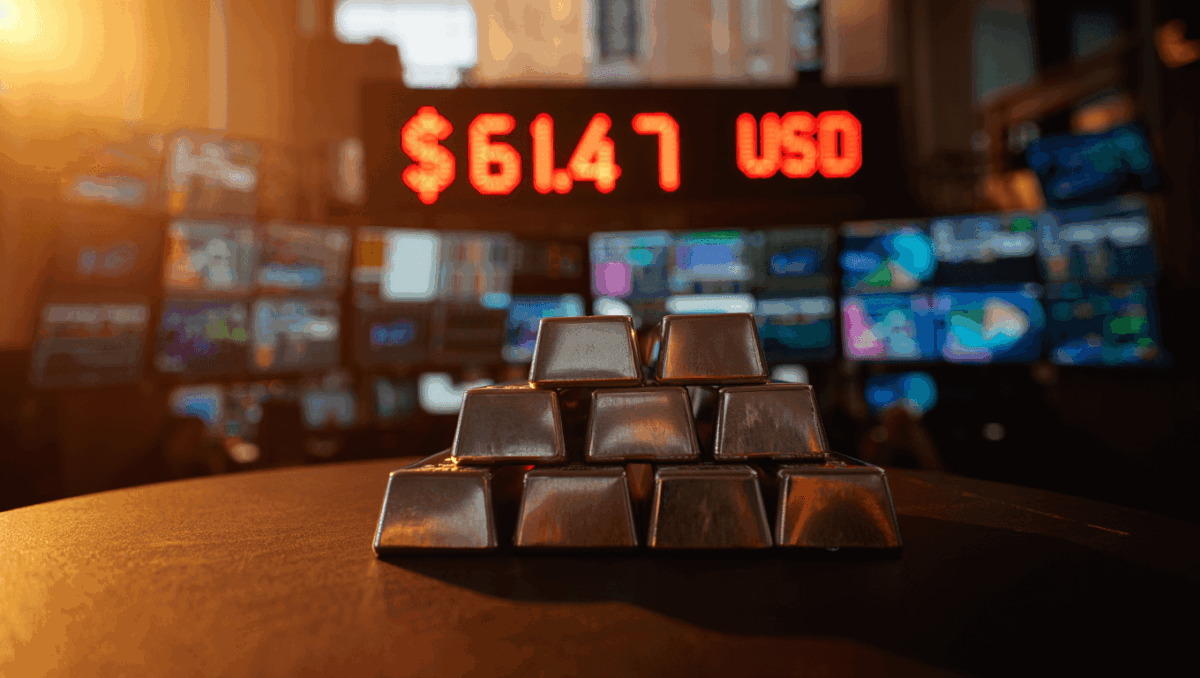
Silver reached a historic milestone today, surging past $61 per ounce for the first time ever, marking the precious metal’s explosive ascent in 2025. The price rally has left gold struggling to keep pace, with silver now up 92 to 102 percent year-to-date depending on the precise timing. This unprecedented surge reflects a perfect storm of tight supply, soaring industrial demand, and investor hedging against economic uncertainty.
🔥 Quick Facts
- Silver hit $61.47 per ounce on December 10, 2025, breaking the all-time record
- Up 92.59 percent year-to-date according to Trading Economics data
- Spot silver first crossed $60 per ounce on December 9, marking a historic threshold
- Silver’s surge of 102 percent in 2025 dramatically outpaced gold’s 59 percent gain
Historic Price Surge Breaking All Previous Records
Intuit emerges as best software stock for 2026 while stock crashes to bargain levels analysts didn’t expect
2026 tax brackets shock Americans with hidden paycheck truth nobody expected
The precious metals market witnessed an extraordinary moment this week as silver finally breached the $60 per ounce milestone for the first time in history. This breakthrough, achieved on December 9, 2025, continued accelerating higher to reach approximately $61.47 per ounce by Wednesday morning. Market data from Trading Economics and Kitco confirmed the price spike, with spot silver marking gains of 1.35 percent from the previous trading day alone.
The previous peak for silver in 2025 occurred in late November when the metal hit $57.16 per ounce, a 90 percent year-to-date gain at that time. The $61 barrier represents not just a new record, but validation that the rally is not merely a technical bounce but a fundamental repricing of the asset. Historical context matters here: in 1980, silver’s previous all-time high stood at $49.45 per ounce, which would adjust to approximately $194.42 when accounting for inflation to 2025 dollars.
What’s Driving the Explosive Silver Surge This Year
Marcus Lemonis takes CEO role at Bed Bath & Beyond with $25M cost-cutting plan and watch what industry experts are saying about his next move
SPX surges 34 points at open with shocking tech recovery, here’s what caused the unexpected Venezuela rally
Multiple converging factors have created a structural supply squeeze in the physical silver market. Industrial demand accounts for approximately 50 percent of total silver demand, according to the Silver Institute, with applications spanning electronics, solar panels, medical devices, and industrial manufacturing. Tight supply from mining regions coupled with surging manufacturing demand has created unexpected scarcity in the spot market.
Beyond industrial factors, investors are aggressively accumulating silver as a hedge against economic turbulence and currency weakness. ETF inflows have jumped dramatically, with 15.7 million ounces flowing into silver exchange-traded funds in recent weeks alone. Monetary factors also play a critical role: expectations of future Federal Reserve rate cuts and concerns about inflation make precious metals attractive alternatives to bonds and cash. The psychological breakthrough of crossing $60 per ounce has accelerated retail investor interest, with trading platforms reporting dramatic increases in silver search volume and order activity.
| Price Level | Date Achieved | Year-to-Date Gain |
| $57.16 per ounce | Late November 2025 | 90% |
| $60.00 per ounce | December 9, 2025 | 100%+ |
| $61.47 per ounce | December 10, 2025 | 92.59% |
Why Silver Is Massively Outpacing Gold in This Bull Market
The gold-to-silver ratio has compressed to 2025 lows as silver dramatically outperforms. While gold climbed 59 percent this year, silver’s 102 percent gain represents a fundamental shift in how investors view the two metals. According to Bloomberg analysis, silver’s more volatile price movements reflect its dual nature: it functions as both a monetary hedge like gold, plus it faces structural supply tightness from heavy industrial usage. This combination creates sharper upside moves than gold alone can achieve.
Major financial institutions acknowledge this shift. Citi now forecasts silver reaching $62 per ounce in coming sessions, while Bank of America projects silver averaging $56 in 2026 with potential peaks near $65. The divergence reflects recognition that silver has fundamentally repriced relative to gold, not a temporary correction. Retail investors have noticed the opportunity: futures markets show growing long positions, and specialty investment platforms report sustained high demand for silver coins and bullion versus historical trends.
What Comes Next for Silver Prices in 2026 and Beyond?
Analyst consensus for 2026 clusters around a $56 to $65 price range, according to major banks surveyed. However, this represents a substantially higher floor than pre-2025 baseline prices, reflecting structural changes in silver supply-demand dynamics. Potential upside targets emerge if industrial demand accelerates from renewable energy expansion, consumer electronics demand, and green technology adoption. Downside risks center on potential economic slowdown reducing manufacturing demand and Federal Reserve rate increases making precious metals less attractive.
“Silver has more than doubled in 2025, reaching a new all-time high near USD 60 on a rare alignment of monetary, structural and physical-market factors.”
— Saxo Bank, Commodities Analysis
Will Silver Break $75 or Face a Pullback from These Historic Levels?
The breakthrough above $60 creates a psychological inflection point. Technical traders monitoring silver note that the metal has decisively broken above all previous resistance levels, potentially opening the door to $65, $70, and even targets of $75 per ounce if momentum sustains. Supply-side constraints from mining limitations and rising industrial consumption could theoretically support further appreciation. However, markets that surge 100 percent in single years often experience consolidation phases, and silver is no exception.
Several competing scenarios could unfold in coming quarters. Most likely: silver consolidates between $55 and $65 through early 2026 as participants book profits, followed by a higher retest if supply tightness persists. More bullish: supply crisis fears trigger tactical buying, pushing silver above $70. More bearish: economic slowdown fears trigger a pullback toward $50 as industrial demand concerns resurface. The answer likely depends on whether Federal Reserve rate cuts continue materializing and whether geopolitical tensions elevate safe-haven demand for precious metals.
Sources
- Trading Economics – Real-time silver spot price data and year-over-year performance metrics
- Reuters – Market news coverage and analyst commentary on silver price movements
- Washington Post / Bloomberg – Economic analysis of silver surge drivers and industrial demand trends

Patrick Graham is a business and finance journalist translating Wall Street’s complexities into stories that matter to everyday readers. With extensive experience in financial journalism and economic analysis, this expert journalist provides sharp insights on market trends, corporate developments, and the economic forces affecting daily life. His reporting helps readers make sense of the business world’s biggest moves.