
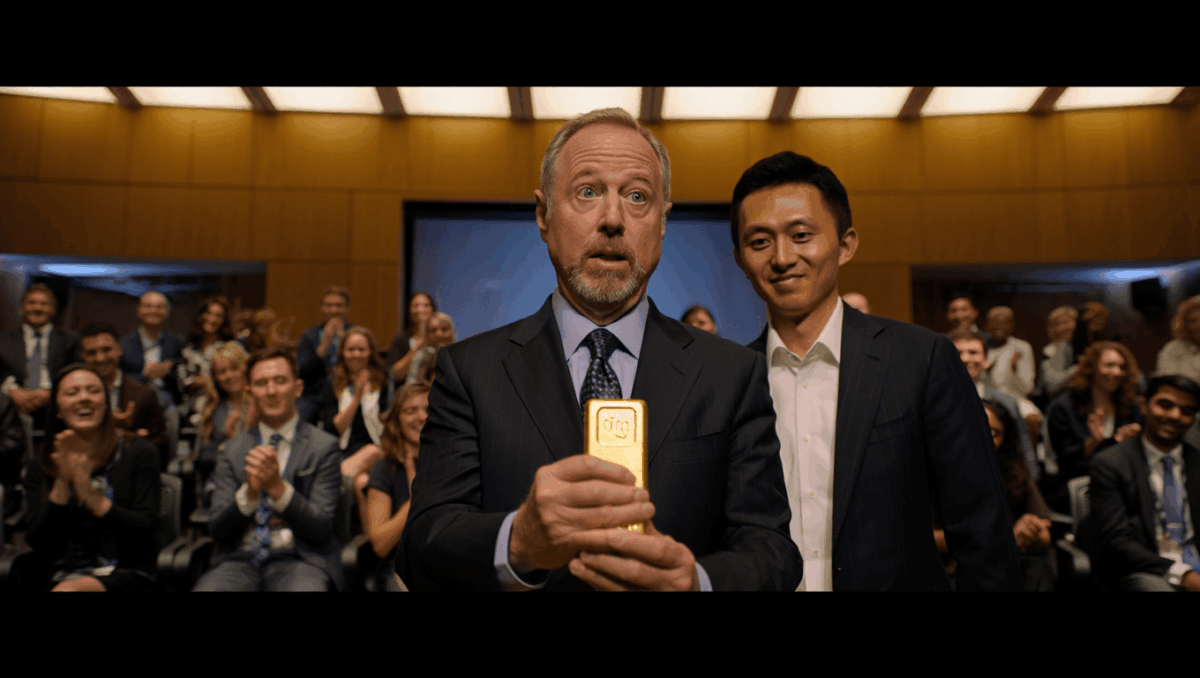
Peter Schiff faced a viral moment during the Binance Blockchain Week Dubai debate on December 4, 2025. When Changpeng Zhao (CZ) handed him a 1-kilogram physical gold bar and asked if it was genuine, the gold advocate couldn’t verify its authenticity without lab testing. The moment became a pivotal demonstration of Bitcoin’s major advantage over gold: instant, cryptographic verification.
🔥 Quick Facts
- The debate occurred on December 4, 2025 at Binance Blockchain Week in Dubai
- Schiff admitted “I don’t know” when asked to authenticate the gold bar on stage
- Online sentiment strongly favored CZ in public reaction across social media platforms
- The debate lasted over 40 minutes covering payments, value storage, and asset adoption
The Gold Bar Moment That Changed Everything
Intuit emerges as best software stock for 2026 while stock crashes to bargain levels analysts didn’t expect
2026 tax brackets shock Americans with hidden paycheck truth nobody expected
During the 40-minute debate, CZ handed Schiff a gold bar marked “Kyrgyzstan, 1,000 grams, fine gold, 999.9” with a serial number. He then asked the million-dollar question: “Is it real gold?”
Schiff’s honest response—”I don’t know”—drew immediate laughter and applause from the crypto-native audience. The moment perfectly illustrated Bitcoin’s core advantage: any user can instantly verify transactions on the blockchain through cryptographic methods, while physical gold requires expensive, destructive testing procedures to confirm authenticity.
Marcus Lemonis takes CEO role at Bed Bath & Beyond with $25M cost-cutting plan and watch what industry experts are saying about his next move
SPX surges 34 points at open with shocking tech recovery, here’s what caused the unexpected Venezuela rally
According to the London Bullion Market Association, the only 100% definitive verification method for gold is fire assaying, which involves melting it down. This destructive testing contradicts Schiff’s primary argument that gold is a superior, tangible asset.
CZ’s Bitcoin Adoption Argument Dominated the Stage
CZ emphasized real-world utility over theoretical definitions. He highlighted that Bitcoin now has 300 million users on Binance alone and millions using cryptocurrency for actual payments across emerging markets.
He shared a compelling story about a user in Africa who reduced bill payments from three days to three minutes using crypto. When Schiff dismissed crypto payment cards as merely “selling Bitcoin for dollars,” CZ countered: “It works. Users use crypto. Merchants get paid. That is utility.”
The Binance founder also presented Bitcoin’s biggest advantage: complete supply transparency. “We literally do not know how much gold exists,” CZ stated, while “with Bitcoin, we know exactly how much there is and where it is.” This finite, auditable supply contrasts sharply with gold reserves that remain partially unknown.
| Debate Aspect | CZ’s Position | Schiff’s Position |
| Value Source | Adoption by 300M+ users globally | Gold’s physical properties and industrial use |
| Verification | Instant cryptographic confirmation | Expensive lab testing required |
| Supply Transparency | Exactly known and auditable | Partially unknown gold reserves globally |
| Real-World Payments | Millions of active transactions daily | Bitcoin lacks commercial payment utility |
| Long-Term Performance | Outperformed all assets over 15 years | Gold beat Bitcoin over past 4 years |
Schiff’s Theoretical Arguments Clashed with Market Reality
Peter Schiff leaned heavily on textbook definitions, arguing that Bitcoin lacks intrinsic value because it serves no industrial purpose. He repeatedly called Bitcoin “a speculative digital collectible people only buy because they think it will go up.”
However, CZ cited actual adoption metrics that contradicted this claim. When asked about next-generation preferences, CZ stated: “Young people understand digital value. Bitcoin is global, mobile, and censorship-resistant. It is built for their world—not the old one.” The audience reaction suggested overwhelming agreement with his forward-looking perspective.
Schiff countered that Bitcoin isn’t priced in real transactions and lacks the historical trust that gold has maintained for centuries. Yet his own inability to authenticate the gold bar on stage undermined this stability argument, since physical gold’s “trustworthiness” still depends on third-party verification systems.
“Value is not determined by physical properties. Google, X, software—all are intangible, yet essential. Bitcoin is the most secure, transparent monetary network ever built.”
— Changpeng Zhao, Binance Founder
Why Did Peter Schiff Lose the Bitcoin vs Gold Debate in Dubai?
The viral moment of Schiff saying “I don’t know” when challenged to authenticate the gold bar encapsulated the entire debate’s outcome. CZ repeatedly weaponized Bitcoin’s technological advantages against Schiff’s reliance on historical monetary theory.
On X and across social media platforms, sentiment overwhelmingly favored CZ’s performance over Schiff’s arguments. crypto analysts noted that Schiff’s talking points felt anchored in 20th-century monetary thinking, while CZ presented a vision aligned with how billions actually use money today: digitally, instantly, and across borders.
The debate also revealed Schiff’s circular logic: he defended gold as superior because it’s tangible, but then couldn’t verify that tangibility without outside help. Bitcoin requires no intermediary to confirm ownership or transfer value. This fundamental difference shaped how the audience perceived each speaker’s credibility on the topic of future-proof assets.
Watch: The Full Bitcoin vs Gold Debate

Sources
- Cointelegraph/TradingView — Peter Schiff’s inability to authenticate the gold bar during the onstage test
- CryptoPotato — CZ vs. Peter Schiff debate analysis and audience sentiment assessment
- Binance Official — Complete debate coverage and CZ’s arguments for Bitcoin adoption

Patrick Graham is a business and finance journalist translating Wall Street’s complexities into stories that matter to everyday readers. With extensive experience in financial journalism and economic analysis, this expert journalist provides sharp insights on market trends, corporate developments, and the economic forces affecting daily life. His reporting helps readers make sense of the business world’s biggest moves.