
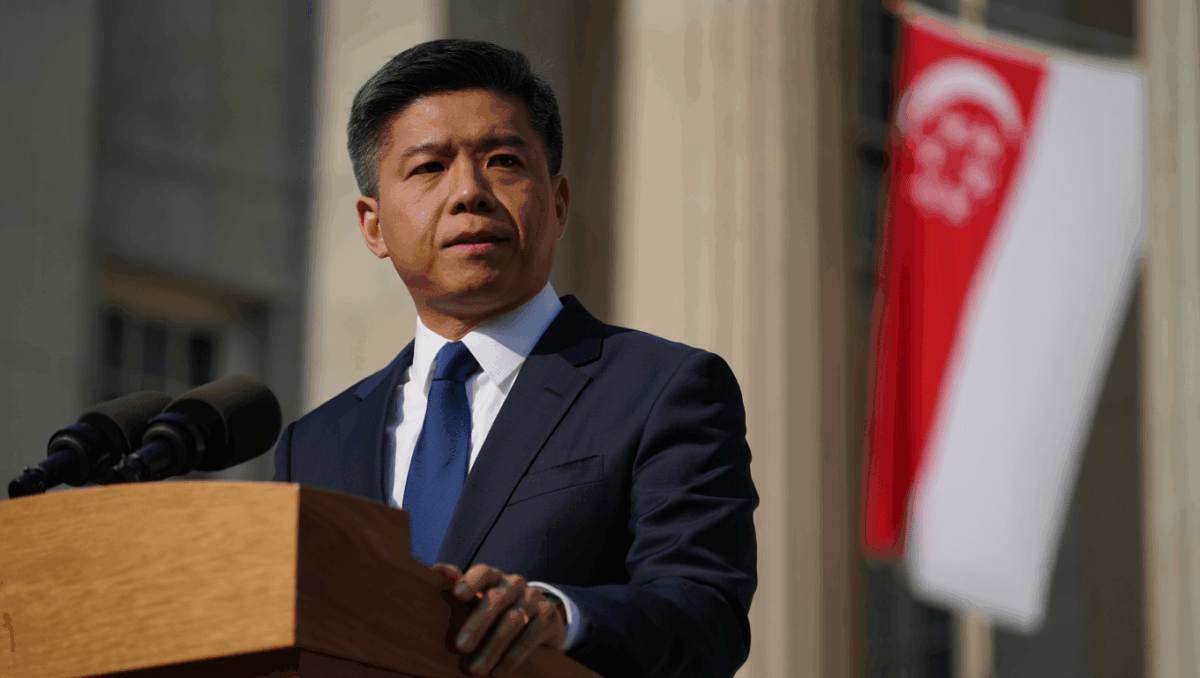
Singapore’s economy delivered a stronger-than-expected 4.8% growth in 2025, exceeding official forecasts amid global uncertainties. However, Prime Minister Lawrence Wong issued a candid warning that sustaining this pace will prove challenging in the year ahead.
🔥 Quick Facts
- Singapore’s 2025 GDP growth reached 4.8%, outperforming earlier forecasts of around 4%
- Growth surpassed 2024’s 4.4% and exceeded MAS forecast and private sector economist predictions
- AI-driven semiconductor demand and resilient global economy boosted the island nation’s performance
- PM Wong pledged to “rethink, reset, and refresh” economic strategies as fractured trade becomes permanent
Why Singapore’s Economy Beat Forecasts by Such a Wide Margin
Intuit emerges as best software stock for 2026 while stock crashes to bargain levels analysts didn’t expect
2026 tax brackets shock Americans with hidden paycheck truth nobody expected
Prime Minister Lawrence Wong identified three key factors driving stronger-than-expected growth in his December 31 New Year message. First, global economic growth proved more resilient than anticipated at the year’s start. Second, US tariffs arrived later and at lower levels than many economists had feared, avoiding the worst-case scenario for Singapore’s trade-dependent economy.
The third factor was particularly crucial: Singapore benefited enormously from the artificial intelligence boom. Massive global demand for semiconductors and electronics driven by AI applications created unexpected opportunities for the city-state’s tech manufacturing sector. These three tailwinds combined to push unemployment and inflation to remain low while real incomes increased across the population.
Singapore’s Economic Growth Accelerates While Regional Peers Struggle
Marcus Lemonis takes CEO role at Bed Bath & Beyond with $25M cost-cutting plan and watch what industry experts are saying about his next move
SPX surges 34 points at open with shocking tech recovery, here’s what caused the unexpected Venezuela rally
This year’s performance marks a significant acceleration. Singapore’s 4.8% growth exceeded last year’s 4.4% and surpassed the Monetary Authority of Singapore’s official forecast of around 4%. Even more impressively, it beat private sector economist predictions of 4.1%, indicating that even seasoned market watchers underestimated the economy’s strength.
The Ministry of Trade and Industry had upgraded its 2025 forecast to “around 4%” in November, moving sharply upward from an earlier range of just 1.5% to 2.5%. This dramatic revision in just two months underscores how rapidly conditions shifted as semiconductors and AI-related demand accelerated into the final quarter of 2025.
| Economic Metric | 2025 Figure |
| GDP Growth Rate | 4.8% (actual year-end result) |
| Latest MTI Forecast | Around 4.0% (upgraded in November) |
| MAS Official Forecast | Around 4.0% |
| Economist Survey Average | 4.1% |
| 2024 Growth Rate | 4.4% |
| 2026 Official Forecast | 1.0% to 3.0% |
“Sustaining This Pace Will Be Challenging” – PM Wong’s Sobering Reality Check
While celebrating the strong result, PM Wong struck a cautious tone in his message to residents. He explicitly warned that Singaporeans “must be realistic that sustaining this pace of growth will be challenging”. The headwinds that created 2025’s surge are not expected to persist. US tariffs will remain in place, global trade will continue fragmenting, and geopolitical tensions show no signs of abating.
Wong pointed to permanent structural changes in the global economy that will make future growth harder. Countries are “reconfiguring trade networks and supply chains in the name of resilience and security”, he noted. Fractured trade and geopolitical struggles are no longer temporary disruptions but “permanent features of a fragmented world”. The outlook for 2026 reflects this reality: the government projects growth of just 1.0% to 3.0%, roughly half the 2025 pace.
Economic Strategy Review Signals Major Policy Shift Ahead for Singapore
Recognizing that incremental improvements won’t suffice, PM Wong announced that Singapore must “rethink, reset, and refresh” its economic strategies. He emphasized that “we cannot simply do more of the same” to remain competitive. Deputy Prime Minister Gan Kim Yong is leading a task force of younger political office-holders on this ambitious Economic Strategy Review.
The first set of proposals from this initiative will be released soon, and the government will formally respond at Budget 2026, expected to be delivered in February 2026. This comprehensive rethink suggests major policy changes may be coming to address challenges from aging population to clean energy needs. The focus will center on ensuring “every Singaporean benefits from the nation’s progress”, with emphasis on workers’ career advancement, education, housing, healthcare, and support for lower-income families and people with disabilities.
What does Singapore’s economic performance tell us about 2026 and beyond?
Singapore’s 2025 achievement was remarkable, but it masked underlying fragility. The economy relied heavily on temporary tailwinds – a uniquely strong global environment, delayed tariffs, and the AI boom’s early stage. As these conditions normalize, growth will likely moderate significantly. PM Wong’s warning about “more obstacles to growth and intensifying inflationary pressures” signals that 2026 could be considerably tougher.
The Economic Strategy Review becomes crucial because Singapore faces fundamental challenges: rapid population aging, declining birth rates, energy security concerns, and supply-chain vulnerabilities. The island nation must find new sources of growth beyond the semiconductor surge. According to PM Wong, possible solutions range from securing clean energy imports via the ASEAN Power Grid to exploring low-carbon hydrogen and nuclear energy options. Yet these are long-term bets that won’t immediately offset the loss of 2025’s momentum.

Patrick Graham is a business and finance journalist translating Wall Street’s complexities into stories that matter to everyday readers. With extensive experience in financial journalism and economic analysis, this expert journalist provides sharp insights on market trends, corporate developments, and the economic forces affecting daily life. His reporting helps readers make sense of the business world’s biggest moves.