
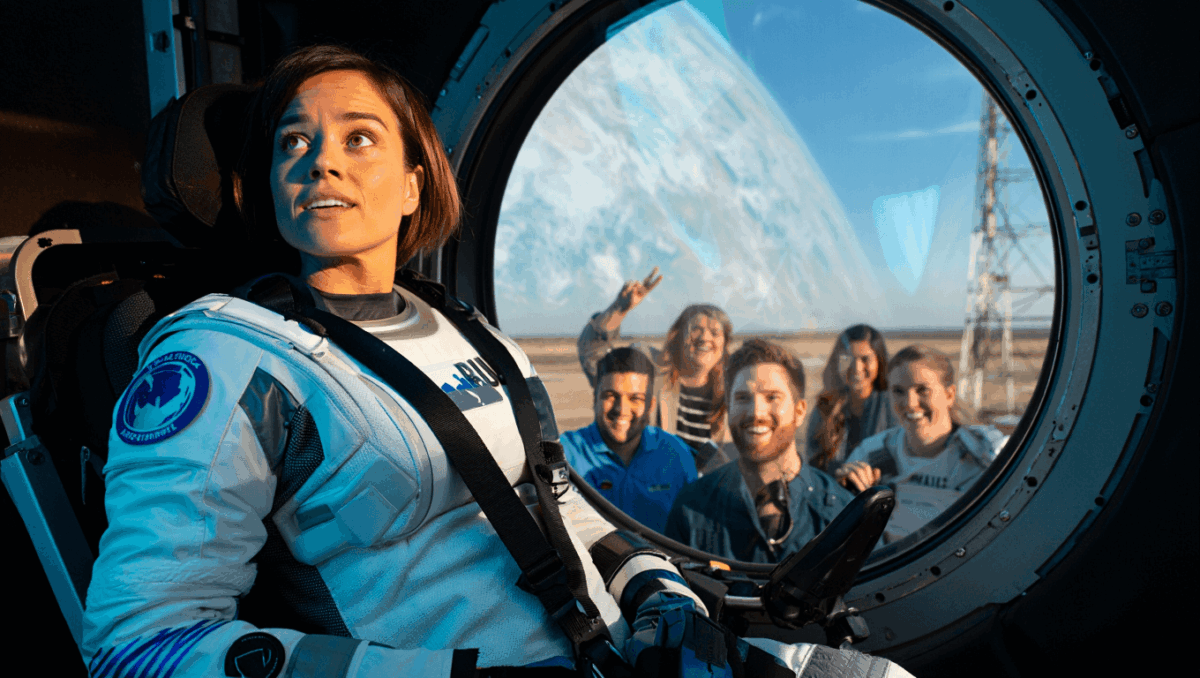
Blue Origin made history this morning when Michaela “Michi” Benthaus became the first wheelchair user ever to reach space aboard the NS-37 suborbital flight. The German aerospace engineer crossed the Kármán line at 62 miles above Earth, shattering barriers for disabled astronauts worldwide. Today marks an unprecedented moment for space tourism and accessibility.
🔥 Quick Facts
- Michaela Benthaus launched from Blue Origin’s Launch Site One in West Texas at 9:30 AM ET on December 20, 2025 after a two-day delay due to technical checks
- The NS-37 mission carried 6 passengers total, with 10-12 minutes of suborbital flight experience and several minutes of microgravity
- Benthaus, a paraplegic engineer from Germany, suffered her spinal cord injury during a mountain biking accident in 2018 but never stopped pursuing her aerospace dreams
- The European Space Agency employee now joins 86 individuals who have crossed the Kármán line aboard Blue Origin rockets
Historic Breakthrough for Accessible Spaceflight
Intuit emerges as best software stock for 2026 while stock crashes to bargain levels analysts didn’t expect
2026 tax brackets shock Americans with hidden paycheck truth nobody expected
Michaela Benthaus made aerospace history this morning when her wildest dream became reality. The German-born aerospace and mechatronics engineer launched aboard Blue Origin’s New Shepard rocket, crossing the internationally recognized boundary of space. Her achievement breaks through decades of outdated assumptions about who belongs in space.
“I am excited to show the world that also wheelchair users can go on a suborbital flight,” Benthaus told ABC News before today’s launch. The engineer’s determination reflects a broader shift in the aerospace industry toward genuine inclusion. Blue Origin’s decision to support this mission signals confidence in wheelchair users’ capabilities for spaceflight.
Marcus Lemonis takes CEO role at Bed Bath & Beyond with $25M cost-cutting plan and watch what industry experts are saying about his next move
SPX surges 34 points at open with shocking tech recovery, here’s what caused the unexpected Venezuela rally
Unlike traditional astronaut programs, Blue Origin’s New Shepard proves that private companies can lead the way in accessibility. The 10-12 minute flight provides passengers with several minutes of weightlessness and stunning views of Earth’s curvature—experiences previously denied to athletes with disabilities.
The Woman Behind the Mission: Benthaus’s Journey
Michaela Benthaus has spent seven years turning adversity into achievement since her 2018 mountain biking accident. Today’s launch represents the culmination of her relentless advocacy for disability inclusion in space exploration. The tireless engineer completed her Zero-G research flight in 2022 and participated in analog astronaut missions.
Beyond spaceflight, Benthaus remains deeply engaged with athletics. She actively competes in wheelchair tennis and continues pursuing sporting activities outside work. Her European Space Agency career has focused on scientific collaboration and advancing interplanetary exploration—missions that now extend to breaking accessibility barriers.
The engineer worked extensively to prepare for this moment, training at Blue Origin’s Launch Site One in Van Horn, Texas. Several photos released before today show her in a capsule mockup, reviewing every detail of the vessel that would carry her to space. Her meticulous preparation paid off this morning.
The NS-37 Crew and Mission Details
| Crew Member | Background |
| Michaela Benthaus | Aerospace and mechatronics engineer at European Space Agency; paraplegic athlete |
| Hans Koenigsmann | German-American aerospace engineer; 20-year SpaceX veteran; reusable spacecraft expert |
| Joel Hyde | Physicist and retired hedge fund partner from Florida; astrophysics Ph.D. (inspired by 1988 Space Shuttle Atlantis launch) |
| Neal Milch | Business executive; Chair of Jackson Laboratory Board; genetic research advocate |
| Adonis Pouroulis | Mining engineer and entrepreneur with 30+ years in natural resources; leads Pella Resources and Chariot Limited |
| Jason Stansell | Space enthusiast from West Texas; Tulane computer science graduate; dedicated flight to brother Kevin (died 2016 from brain cancer) |
The NS-37 mission represents Blue Origin’s 16th human spaceflight and 86th individual to reach the Kármán line. The crew launched from West Texas today after the company postponed the original December 18 launch to conduct additional pre-flight checks. The mission demonstrates how private spaceflight is democratizing access to space.
What This Achievement Means for Disability Inclusion
Today’s successful launch sends a powerful message that disability does not disqualify people from extraordinary experiences. For decades, space agencies maintained restrictive medical standards that excluded disabled astronauts. Blue Origin’s decision to embrace Benthaus challenges those outdated assumptions head-on.
“I am excited to show the world that also wheelchair users can go on a suborbital flight, and I’m really happy that Blue Origin is supporting this.”
— Michaela Benthaus, European Space Agency Aerospace and Mechatronics Engineer
The achievement extends beyond mere symbolism. Benthaus’s successful spaceflight proves that wheelchair users possess the physical and mental capabilities for space tourism. Her preparation—including her 2022 Zero-G flight and analog astronaut training—demonstrates the rigorous standards she meets. Other aerospace companies will inevitably follow Blue Origin’s lead.
This moment also strengthens the case for broader disability representation in space exploration. As more disabled individuals access space, researchers can better understand how different bodies adapt to microgravity. NASA and other space agencies now face pressure to modernize their astronaut selection criteria. Today changed the trajectory of accessibility in spaceflight forever.
Will Blue Origin Lead Further Inclusion in Spaceflight?
Today’s launch raises essential questions about the future of disability inclusion in commercial spaceflight. Will other aerospace companies adopt Blue Origin’s progressive stance? Can the industry develop more accessible spacecraft designs for future missions? How might Benthaus’s achievement inspire policy changes at traditional space agencies?
Blue Origin’s willingness to support this historic mission positions the company as an industry leader in accessibility. The company demonstrated that accommodating diverse passengers doesn’t compromise safety or mission success. As more disabled adventurers seek space experiences, private companies have financial incentive to create inclusive solutions.
Benthaus herself represents an inspiration for disabled athletes and engineers worldwide. Her achievement today proves that wheelchair users can compete at the highest levels of human experience. Tomorrow, other disabled individuals may follow her path to space, powered by the confidence she demonstrated this morning.
Sources
- ABC News – Coverage of the historic NS-37 mission with Michaela Benthaus
- Bloomberg – Blue Origin launches first wheelchair user to space after two-day delay
- The Independent – Paraplegic engineer becomes first wheelchair user to blast off for space

Patrick Graham is a business and finance journalist translating Wall Street’s complexities into stories that matter to everyday readers. With extensive experience in financial journalism and economic analysis, this expert journalist provides sharp insights on market trends, corporate developments, and the economic forces affecting daily life. His reporting helps readers make sense of the business world’s biggest moves.