
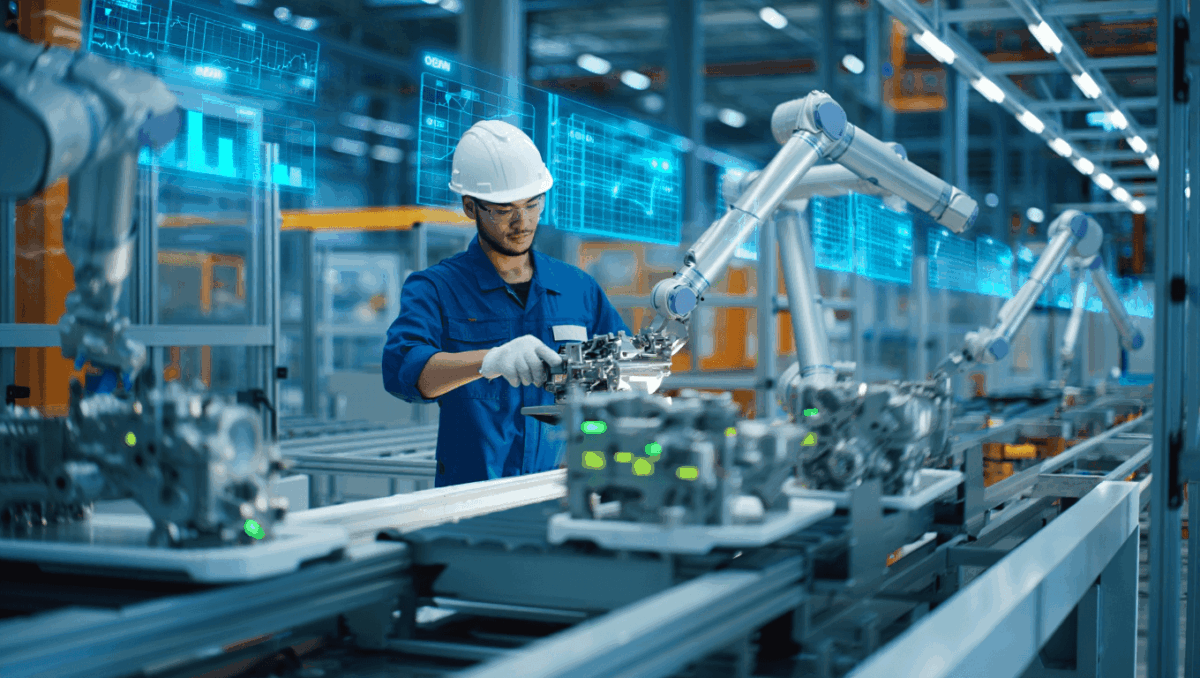
Industry leaders predict 2026 will mark a historic turning point as artificial intelligence transforms manufacturing into a data-driven powerhouse. Global AI spending is projected to reach $2 trillion, with manufacturing at the center of this transformation. This year will see AI move from experimental pilot programs into mainstream production operations.
🔥 Quick Facts
- Global AI spending reaches $2 trillion in 2026, driven by manufacturing investments
- 77% of manufacturers adopted AI in 2024, up from 70% in 2023
- Over 40% of manufacturers will upgrade production scheduling systems with AI capabilities
- Manufacturing adoption grows 30-40% annually as smart factories become standard
Industry Set for Historic 2026 Transformation
Intuit emerges as best software stock for 2026 while stock crashes to bargain levels analysts didn’t expect
2026 tax brackets shock Americans with hidden paycheck truth nobody expected
2026 represents a watershed moment for global manufacturing. After years of experimentation and pilot programs, AI technology moves from the laboratory into production floors worldwide. Major consulting firms including Deloitte, IDC, and PwC predict this shift will reshape competitive dynamics across every manufacturing segment.
What makes 2026 different is the scale of deployment. Companies are no longer asking whether AI works in manufacturing. The question is now how quickly they can implement it. Manufacturers face mounting pressure to adopt intelligent systems or risk losing market share to competitors who do.
AI-Driven Machine Boom Reshapes Production Operations
Marcus Lemonis takes CEO role at Bed Bath & Beyond with $25M cost-cutting plan and watch what industry experts are saying about his next move
SPX surges 34 points at open with shocking tech recovery, here’s what caused the unexpected Venezuela rally
The manufacturing renaissance centers on three critical technologies. Autonomous production scheduling systems use real-time data to optimize shop floor operations. Predictive maintenance algorithms analyze sensor data to prevent equipment failures before they occur. AI copilots guide operators through complex tasks while monitoring manual processes for deviations.
Smart factories equipped with these systems operate fundamentally differently from traditional plants. Supply chains become proactive rather than reactive. Production schedules adjust automatically based on demand fluctuations. Equipment maintenance happens on predictive schedules rather than emergency responses. The result: dramatically improved efficiency and reduced downtime.
| Technology Trend | 2026 Adoption Rate | Primary Benefit |
| AI Production Scheduling | Over 40% of manufacturers | Real-time optimization |
| Predictive Maintenance | Rapid expansion | Prevents equipment failures |
| AI Copilots | Daily factory operations | Worker guidance and safety |
| Digital Twins | Connected ecosystems | End-to-end visibility |
Market Dynamics Favor Manufacturing Renaissance
Economic tailwinds align perfectly with technological advancement. Global GDP is projected to grow 2.8% in 2026, according to Goldman Sachs Research. US economic growth accelerates to 2.6%, while China’s GDP expands 4.8%. This growth provides the expansion capital manufacturers need for AI investments.
The financial case for AI adoption strengthens as deployment costs decline. Machine-as-a-service models allow smaller manufacturers to access sophisticated AI without massive upfront capital. Cloud-based platforms reduce implementation complexity. The combination makes AI adoption feasible across industrial sectors previously unable to justify such investments.
“Industry experts anticipate that AI will move beyond its buzzword status to become a genuine efficiency engine, with manufacturers learning to leverage artificial intelligence for process optimization and automation improvements they haven’t yet addressed.”
— Design News, Manufacturing Analysis
Competitive Pressure Drives Industry-Wide Transformation
Manufacturers face intensifying pressure to modernize or become obsolete. AI adoption increases operating margins by reducing waste, minimizing downtime, and optimizing resource allocation. Companies that delay AI implementation risk competitive disadvantage in 2026 and beyond.
The transformation extends beyond large corporations. Small and medium-sized manufacturers increasingly gain access to affordable AI solutions through cloud platforms and managed services. This democratization of AI technology levels the competitive playing field. Regional manufacturers can now compete with global giants by implementing sophisticated automation and predictive systems.
What Opportunities Await Manufacturing Leaders in 2026?
The historic 2026 transition offers tremendous opportunities for forward-thinking organizations. Early adopters gain market share as they realize efficiency gains before competitors. Skilled workers transition into supervisory and maintenance roles rather than disappearing. Innovation accelerates as AI-powered product development reduces design cycles and improves optimization.
Companies that successfully navigate this transformation emerge stronger. They achieve lower production costs, higher quality outputs, and greater responsiveness to market demands. The winners in 2026 won’t necessarily be the largest manufacturers—they’ll be the ones who best integrate human workers with AI-powered systems and commit to continuous learning and adaptation.
Sources
- IDC – 2026 Manufacturing Industry FutureScape predictions
- Deloitte Insights – 2026 Manufacturing Industry Outlook report
- PwC – 2026 AI Business Predictions and enterprise strategy

Patrick Graham is a business and finance journalist translating Wall Street’s complexities into stories that matter to everyday readers. With extensive experience in financial journalism and economic analysis, this expert journalist provides sharp insights on market trends, corporate developments, and the economic forces affecting daily life. His reporting helps readers make sense of the business world’s biggest moves.