
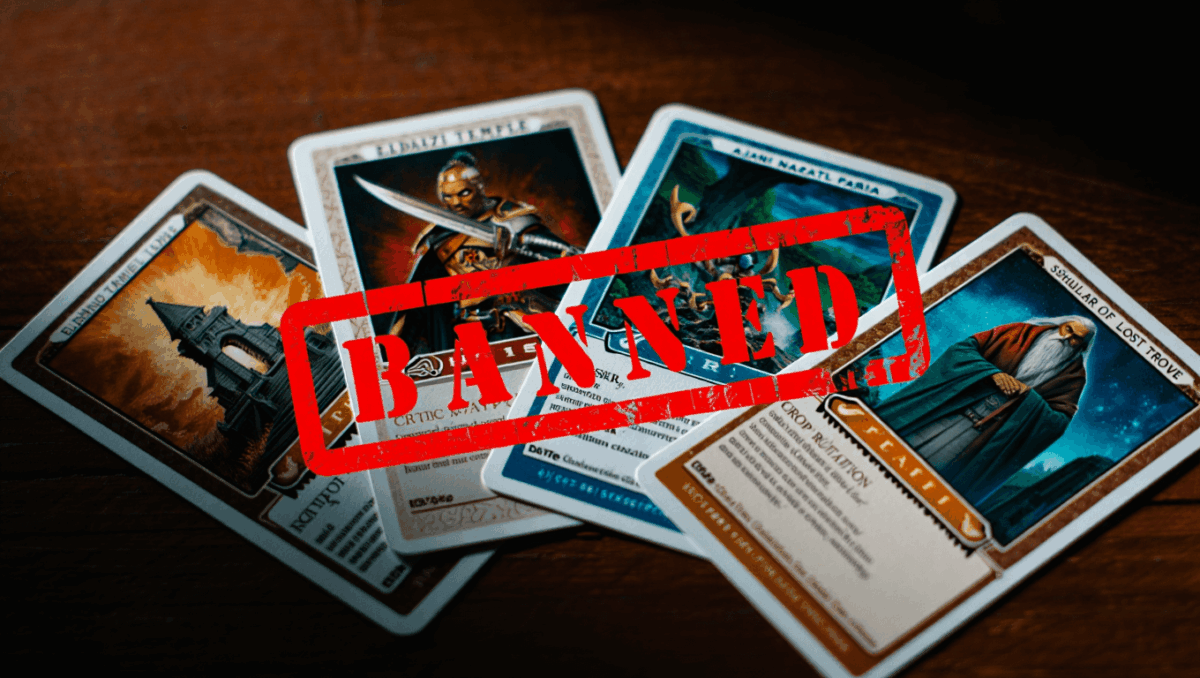
Wizards of the Coast just delivered a major shake-up to the MTG Historic format. Four banned cards including Eldrazi Temple took effect today, reshaping competitive play. Players preparing decks will face a drastically different metagame that rewards strategy over raw dominance.
🔥 Quick Facts
- Ban Date: February 9, 2026, first update of the year affecting Historic
- Cards Banned: Eldrazi Temple, Ajani, Nacatl Pariah, Crop Rotation, Scholar of the Lost Trove
- Cards Unbanned: Seven cards including Force of Negation, Endurance, Magus of the Moon
- Reason: Historic needed interactive gameplay to counter linear strategies dominating ranks
Eldrazi Dominance Forces Historic Action
Prime Day gaming deals drop early: save as much as 50% on Switch, PS5 and gaming PCs
Gears of War: E-Day delivers explosive over-the-top action for Xbox owners
Eldrazi strategies reached critical saturation in Historic’s upper ranks. The colorless ramp deck leveraged Eldrazi Temple alongside Ugin’s Labyrinth for consistent acceleration. Daniel Xu, the architect of this ban cycle, identified Eldrazi as the most oppressive strategy. Rather than ban both lands, Wizards chose Eldrazi Temple since Ugin’s Labyrinth offered value outside the shell.
Early data showed that Eldrazi threatened to push out slower strategies entirely. The deck’s ability to cast efficient threats on turn three or four left opponents struggling for answers. Removing Temple slows the ramp engine without eliminating Eldrazi as a viable archetype.
Ajani and Boros Energy Targeted for Balance
Gears of War: E-Day on PC gets Nvidia RTX Mega Geometry and stunning visual upgrade
Wordle Oct. 3 answer could wipe out streaks: how one tough word is tripping players
Boros Energy evolved into a 60% win-rate powerhouse at all ladder segments despite previous nerfs. Ajani, Nacatl Pariah, a two-drop planeswalker, stood as the clear culprit. The card transforms quickly and trades poorly against opposing creatures. Nearly impossible to remove profitably, Ajani generated wins through relentless pressure and card advantage.
Wizards acknowledged that Energy still exists post-ban, but the removal of Ajani raises the format’s interactive ceiling. White strategies beyond Boros Energy were also hit, but designers deemed this collateral necessary to lower overall metagame power.
Historic’s Past Philosophy Versus Present Reality
| Aspect | Original Vision | Current State |
| Banned Cards | Blood Moon, free spells | Power outliers regardless |
| Power Level | Pioneer-equivalent | Modern-tier strategies |
| Play Patterns | Interactive gameplay | Linear combo dominance |
| Recent Catalyst | Controlled growth | Modern Horizons 3 influx |
Modern Horizons 3 fundamentally shifted Historic from a casual-friendly format into a Modern-powered crucible. The Persist reanimator shell featuring Scholar of the Lost Trove illustrated the problem. Players could chain spells starting turn two, ending games before opponents assembled counterplay. Wizards banned Scholar directly to cut off this path.
“Eldrazi is the most dominant strategy in the high ranks of Historic and comes in a variety of flavors, all powered by the ramp from Ugin’s Labyrinth and Eldrazi Temple. This redundancy is key to the consistency and power of the strategy.”
— Daniel Xu, MTG Arena Design Lead
Unbans Add Counterplay Against Dominant Strategies
Wizards executed aggressive unbans targeting seven cards to restore interactive balance. Force of Negation counters combo finales without snowballing game plans. Endurance serves as a main-deck creature answering graveyard strategies. Magus of the Moon and Harbinger of the Seas attack land-based strategies like Eldrazi ramp without the polarizing bloodiness of traditional Blood Moon effects.
This unban philosophy breaks previous Historic doctrine favoring casual accessibility over raw competitive health. Wizards now prioritizes card-by-card power evaluation over blanket heuristics. Crop Rotation‘s ban, conversely, reflects design constraints. The card fueled Lotus Field Combo and locks Historic’s land design space too aggressively.
What’s Next for Historic Players and Format Health?
The announcement signals Wizards will announce seven ban windows in 2026, allowing quicker format maintenance without constant disruption threats. Designer Carmen Klomparens emphasized the goal of balancing regular updates with player confidence in their collections. Historic players should expect continued scrutiny of emerging strategies.
Affinity decks potentially rise in relevance post-ban, targeting Force of Vigor as the primary answer. Slower control decks finally gain footing against linear strategies. The format’s future depends on whether these unbans provide sufficient emergency valves, or if new dominators emerge requiring additional intervention.

Annabelle Ink is a gaming journalist and lifelong gamer who lives and breathes video game culture. From console releases to esports tournaments, this dedicated journalist brings insider knowledge and genuine enthusiasm to every review and feature. Her expertise spans multiple gaming platforms, helping readers discover their next favorite game while staying connected to the pulse of the gaming industry.